PANDA TRAIN · GOLDEN PANDA EXPRESS
Three Millennia of Stories Aboard GOLDEN PANDA EXPRESS
A walk through the interiors of PANDA TRAIN · GOLDEN PANDA EXPRESS, following the thread from ancient Shu silk to the panda patterns of today.
OUR STORY · SILK, POETRY & DESIGN
Our story, woven in silk
Silk reached the Roman world long before its buyers knew much about the people who made it. Classical writers called those distant producers the Seres, the people of silk. The name referred broadly to China, while Chengdu had its own place in that history as a centre of Shu brocade. UNESCO traces these exchanges across the Silk Roads.
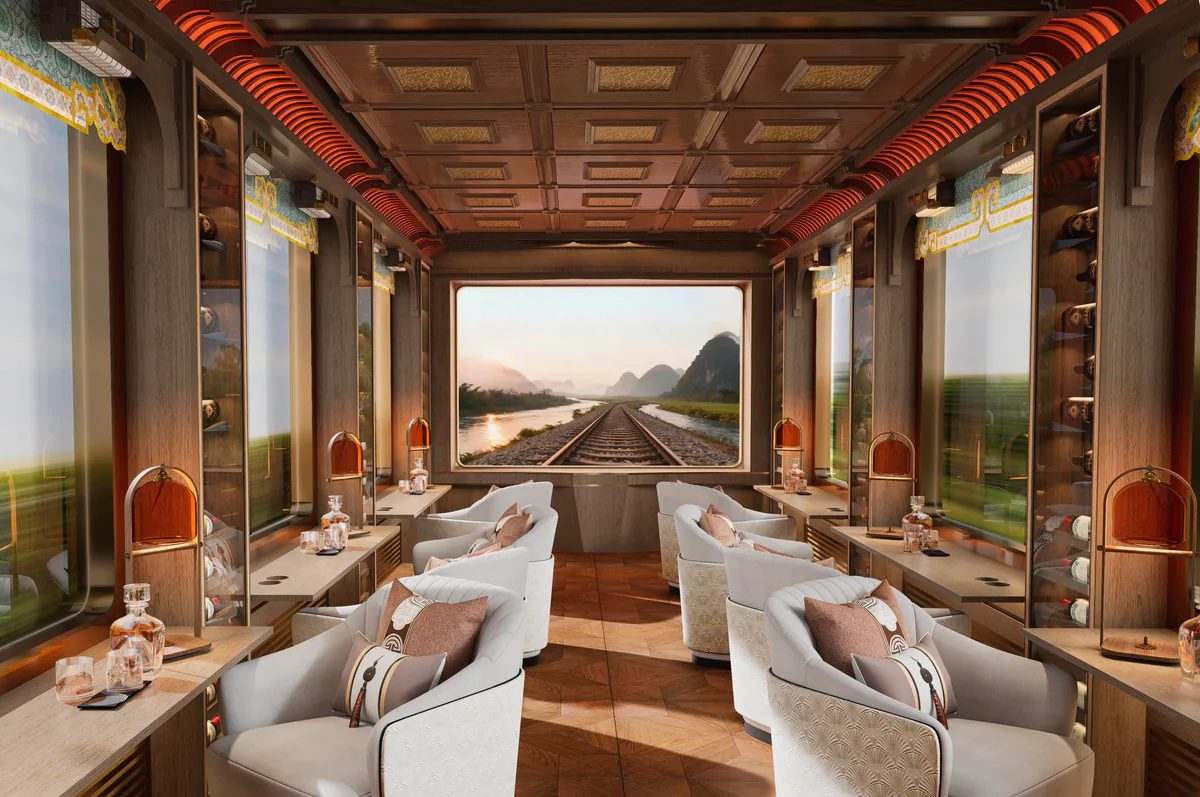
That is where the story of PANDA TRAIN · GOLDEN PANDA EXPRESS begins. In the design account published by PANDA ROAM, the train carries a little of Chengdu west: bamboo latticework, woven patterns, poetry and the familiar black and white of the giant panda. Its planned interiors turn those references into rooms you can walk through.
A journey through time
01 · SHAOCHENG
A welcome woven from Shu brocade
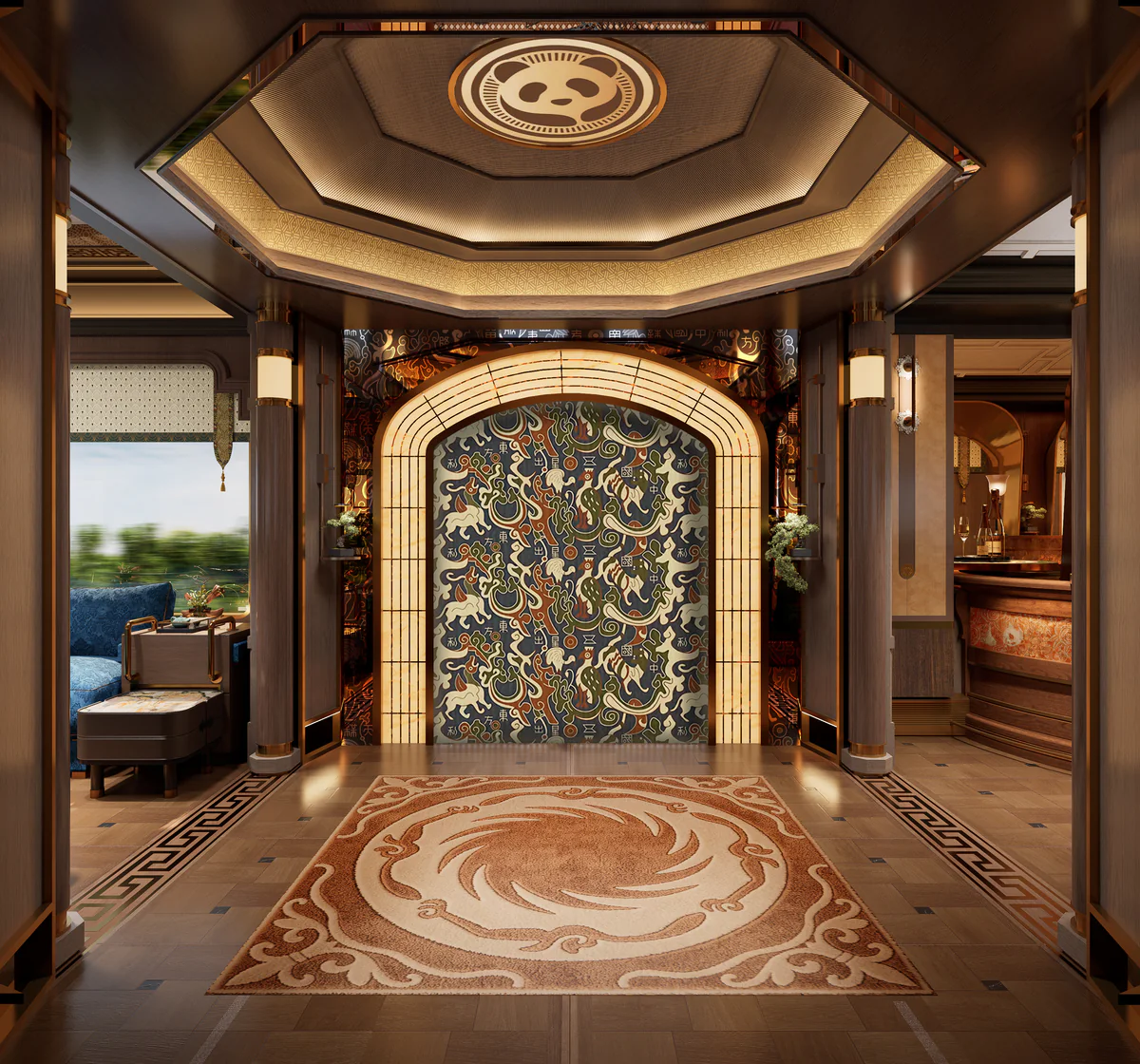
A brocade panel sets the scene in the Shaocheng welcome carriage. Shaocheng takes its name from the smaller historic city within ancient Chengdu, and the welcome carriage borrows that old city's sense of ceremony.
An octagonal ceiling draws the eye upwards. Gold patterns gather towards its centre; below, bamboo lattice screens sit between vermilion columns. Bamboo and brocade, two materials closely associated with Sichuan, set the tone before the journey has begun.
One wall carries a pattern inspired by the brocade armguard known for its inscription, "Five stars rise in the East, benefiting China." The ancient textile was found far from Chengdu, at Niya in Xinjiang. How did a piece of Shu brocade travel so far west? The welcome carriage leaves that thread to be picked up in the next part of the story.
02 · ANCIENT SHU
A thread that reaches back 3,000 years
At Sanxingdui, near Guanghan, the history of silk reaches deep into the ancient Shu world. The site came to modern attention in the 1920s; the two sacrificial pits excavated in 1986 brought its bronze masks, sacred trees and gold staff to wider attention.
More recent research has found silk traces in the pits, including remains on bronze objects and in the surrounding soil. Work reported by the China National Silk Museum gives material evidence for silk use in ancient Shu more than 3,000 years ago.
That long history is the starting point for the train's woven patterns. Silk was part of life in this region long before Chengdu acquired the name "Brocade City."
03 · CHENGDU & THE SILK ROADS
The craft written into Chengdu's names
By the Han dynasty, brocade had become closely tied to Chengdu. That connection survives in familiar names: Jinjiang, the Brocade River; Jinguancheng, the City of Brocade Officials; and Jinli, the old quarter whose name recalls the craft. Stories of washing cloth in the river, officials overseeing production and looms sounding through the streets give those names a place in the train's account of the city.
The cloth travelled further than its makers. In 138 BCE, Emperor Wu sent Zhang Qian towards the western regions. The Records of the Grand Historian describes him finding Shu cloth and bamboo staffs from Qiong in Bactria. Goods from what is now Sichuan had reached markets well to the west before the envoy arrived. The episode is discussed in this account of Zhang Qian's recorded encounter.
Another piece of that history emerged from the desert in 1995. Archaeologists at Niya, in Xinjiang, found the small brocade armguard whose five-colour pattern now appears in the welcome carriage. Jinsha Site Museum describes the textile and its Shu brocade craftsmanship. Its woven words connect the opening room of the train with the old routes across western China.
04 · JINGONG & JINYAN
Brocade takes its place at the table
During the Three Kingdoms period, Shu Han had soldiers to feed and campaigns to fund. In PANDA ROAM's telling, a saying attributed to Zhuge Liang captures the state's dependence on brocade to help finance war. Cloth was a source of income as well as a work of craft. Both dining carriages take their names from it.
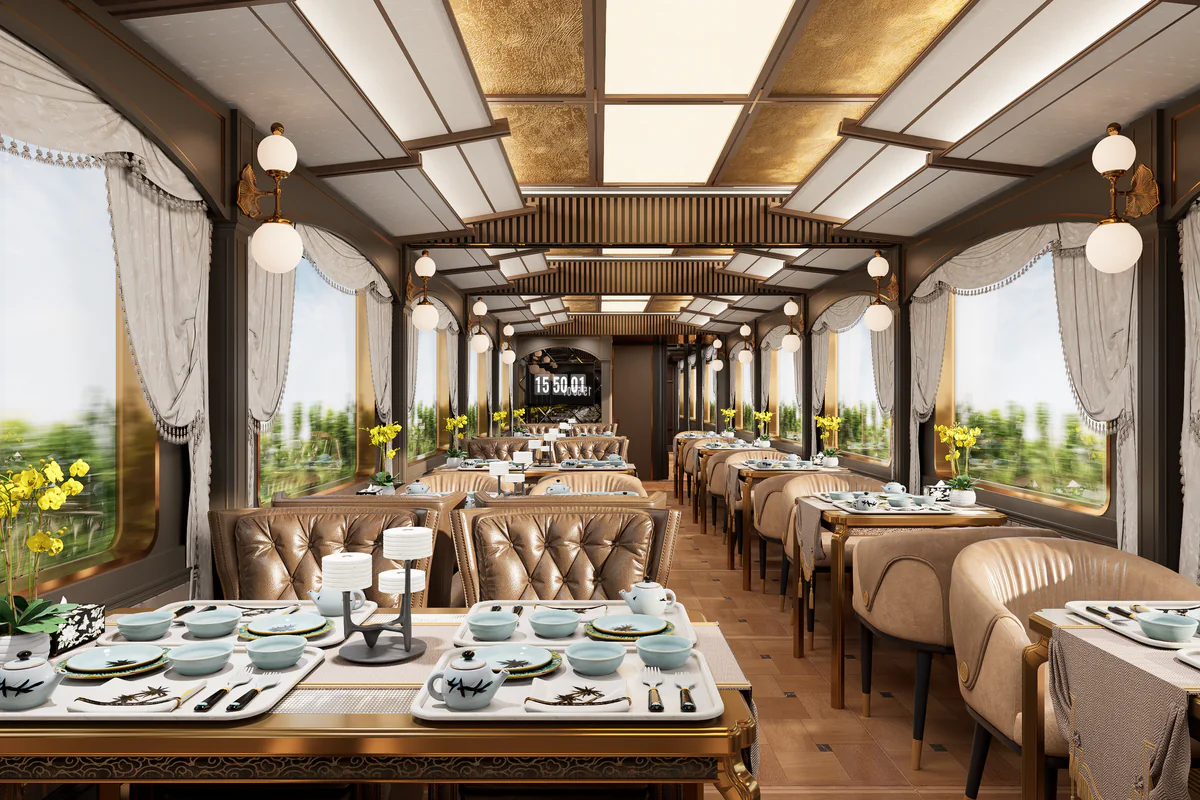
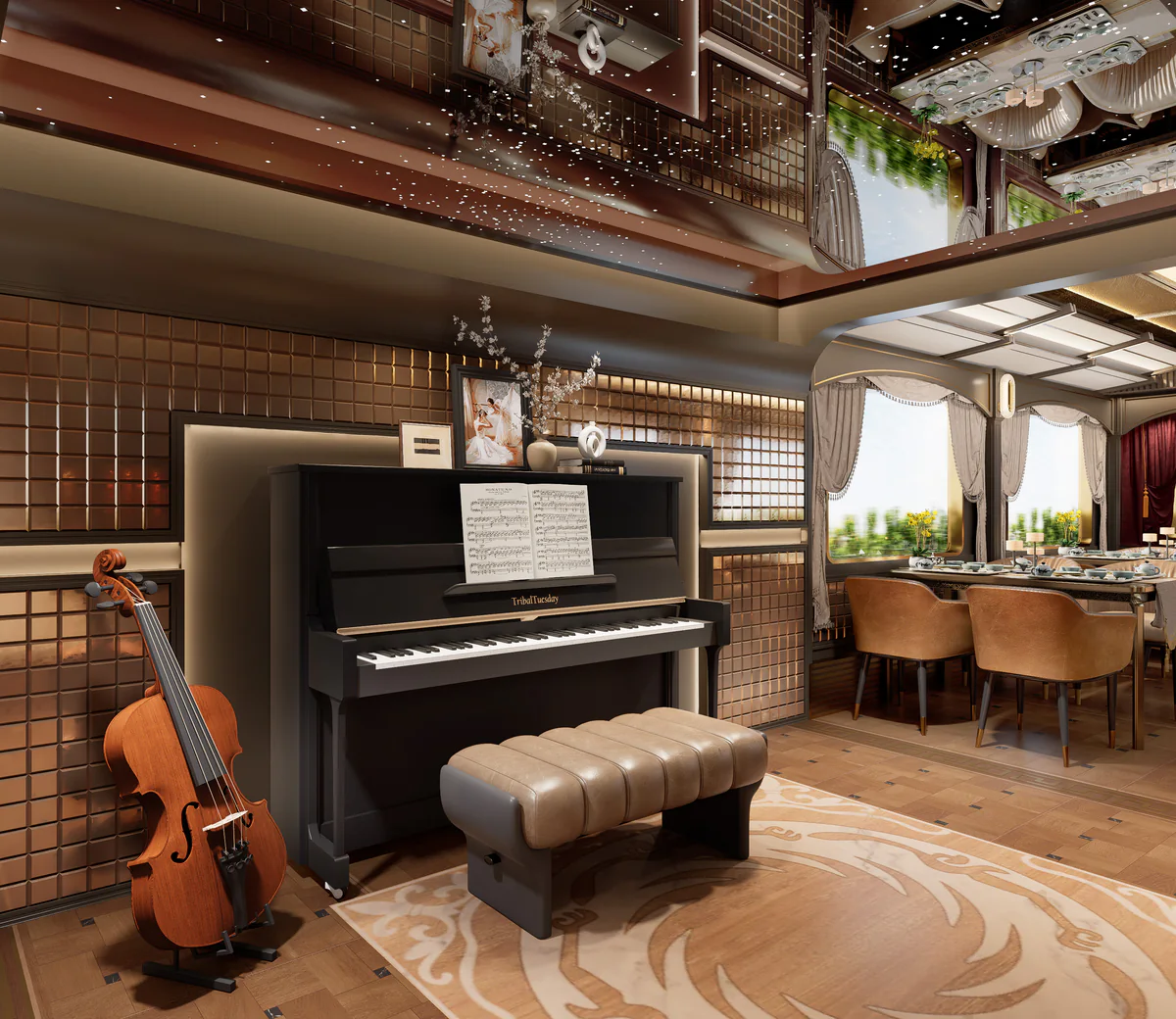
Jingong, the Brocade Palace, is arranged around a custom banquet table with a geometric fret pattern. Window-side booths face the passing view. Shu brocade screens divide the room softly, while celadon tableware and lamps shaped around ginkgo leaves give the setting its colour and detail.
Jinyan, the Brocade Banquet, draws on the imagined scene of a ruler receiving envoys in a palace hall. A long central table anchors the room; the side seating can be divided for smaller parties or brought together. The proposed table setting pairs custom gold-band bone china with vessels inspired by historic gold and silver ware.
The two rooms give the same material different settings: the formality of a palace dining hall and the sociability of a banquet. Brocade supplies both the names and the starting point for the design.
05 · YUNQUE
Tea, poetry and a room for the passing view
Du Fu arrived in Chengdu in the winter of 759, seeking shelter from war, and settled by Huanhua Stream to the west of the city. In his later poem Spring Night Rain, flowers heavy with rain fill the Brocade City at dawn. The old name had lasted into the Tang dynasty and found a home in verse.
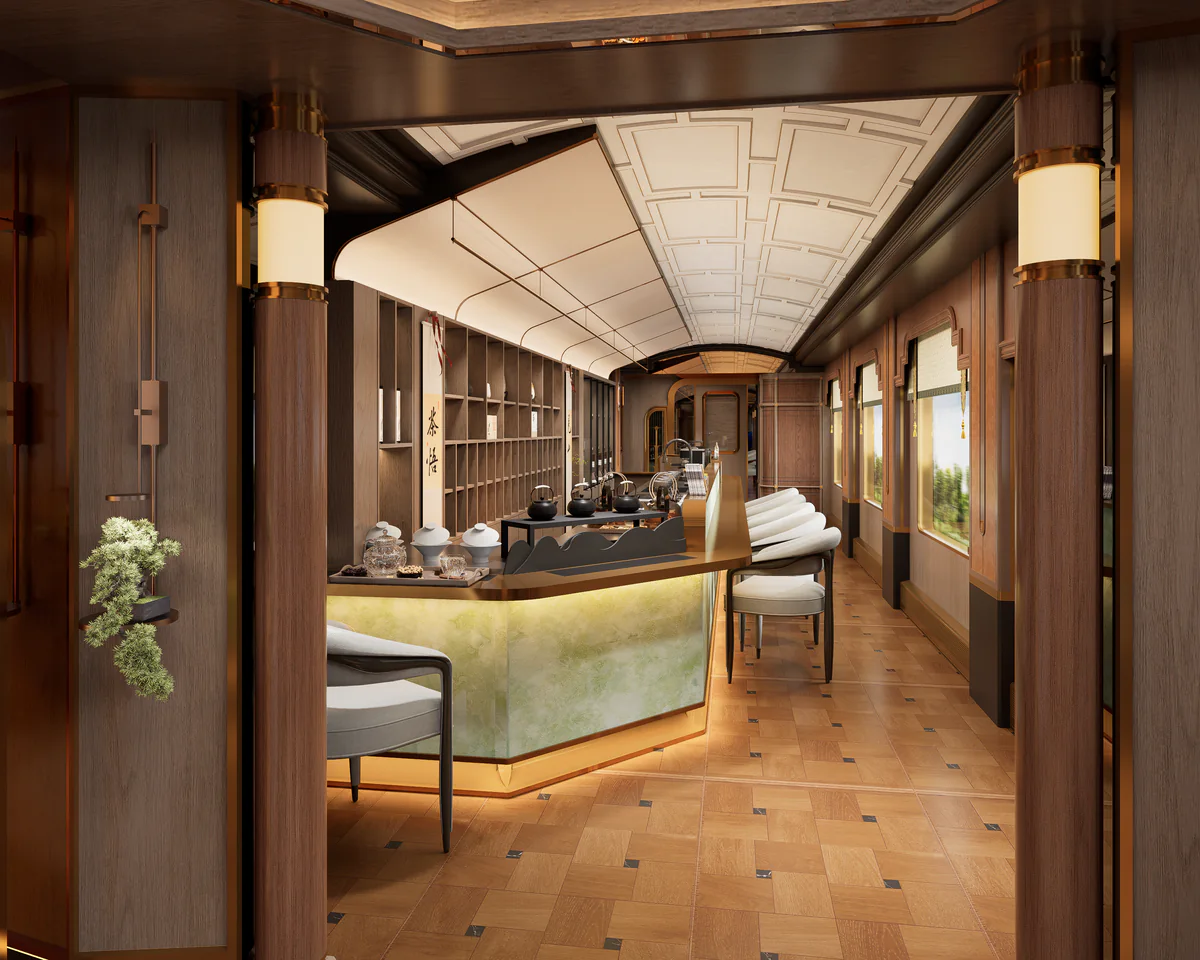
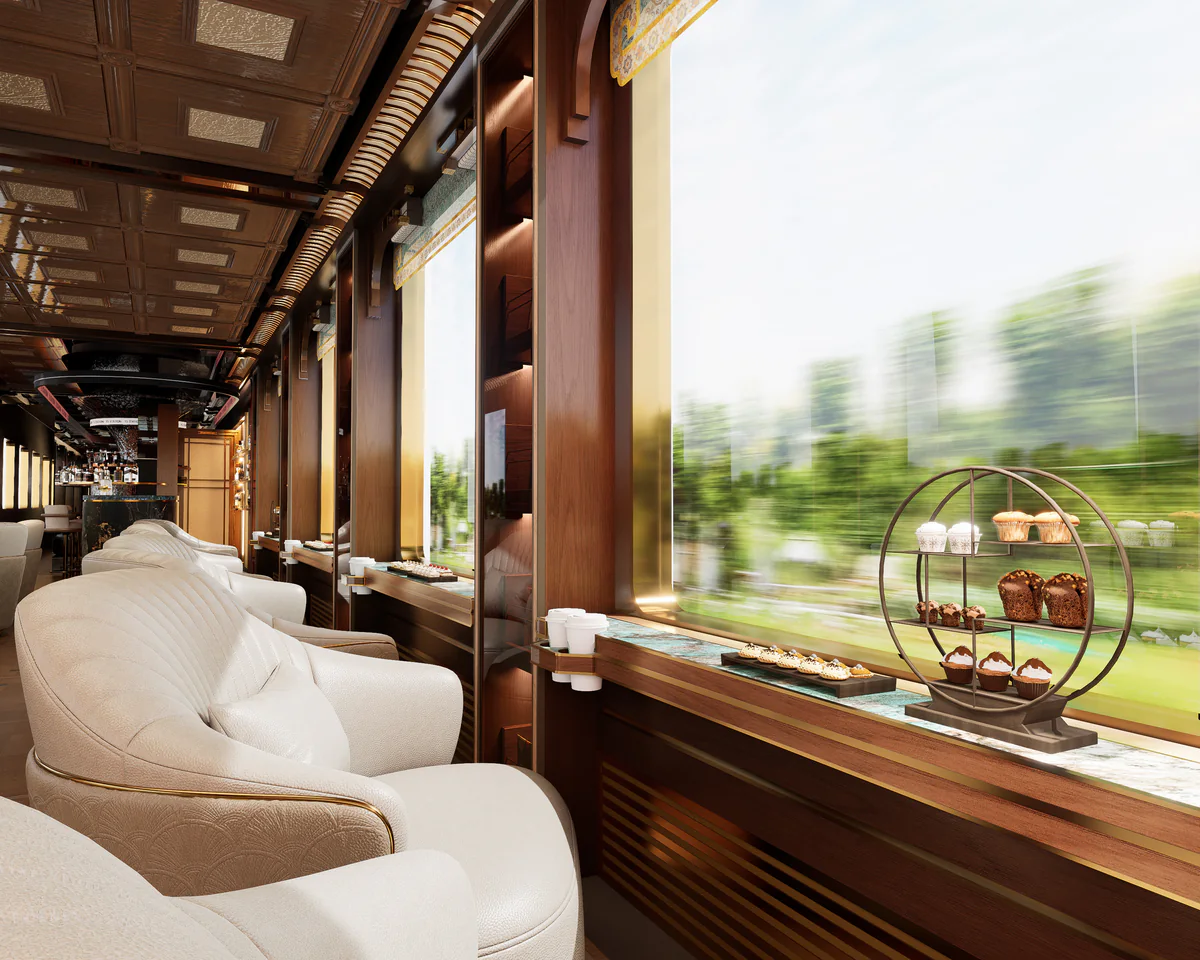
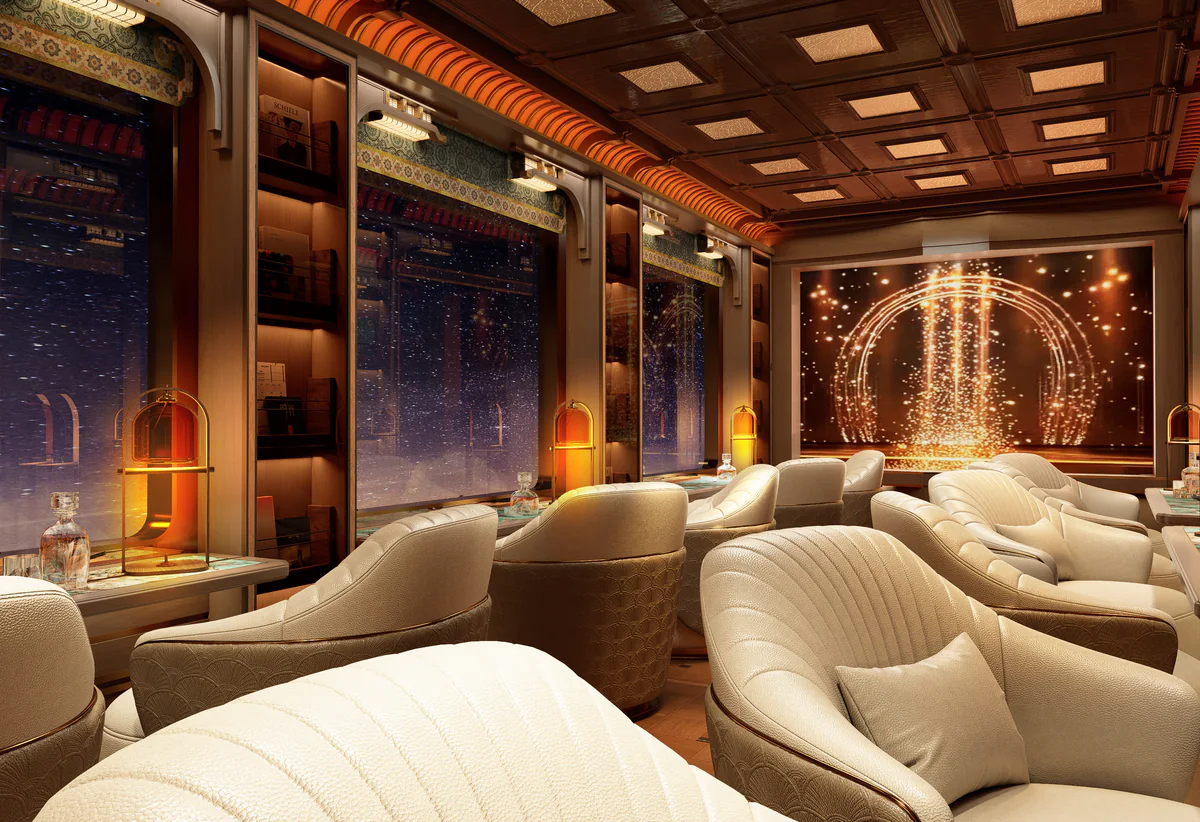
The design story brings that image into Yunque, a name that evokes towers among the clouds. The observation lounge is conceived as a travelling reception room, with space for the sort of conversation, tea and informal gatherings associated with Chengdu's cultural life.
By day, the concept centres on a black and gold tea table, drinks made with Sichuan spirits and wide windows. Desert and mountain scenery belong to the journey's visual story; the actual view will depend on the route and the time of day.
After dark, gold-toned lighting changes the room. PANDA ROAM describes a large screen for music and dance inspired by ancient Shu, Sichuan opera and folk music. These are elements of the lounge concept, a setting intended to move easily from a quiet tea gathering to an evening shared with fellow travellers.
06 · HUAJIAN
A panda among the flowers
The name Brocade City has survived changing dynasties. Today, Sichuan has another familiar emblem: the giant panda. Its black and white outline travels widely too, through panda diplomacy and the curiosity of visitors who come to see the animal in its home region.
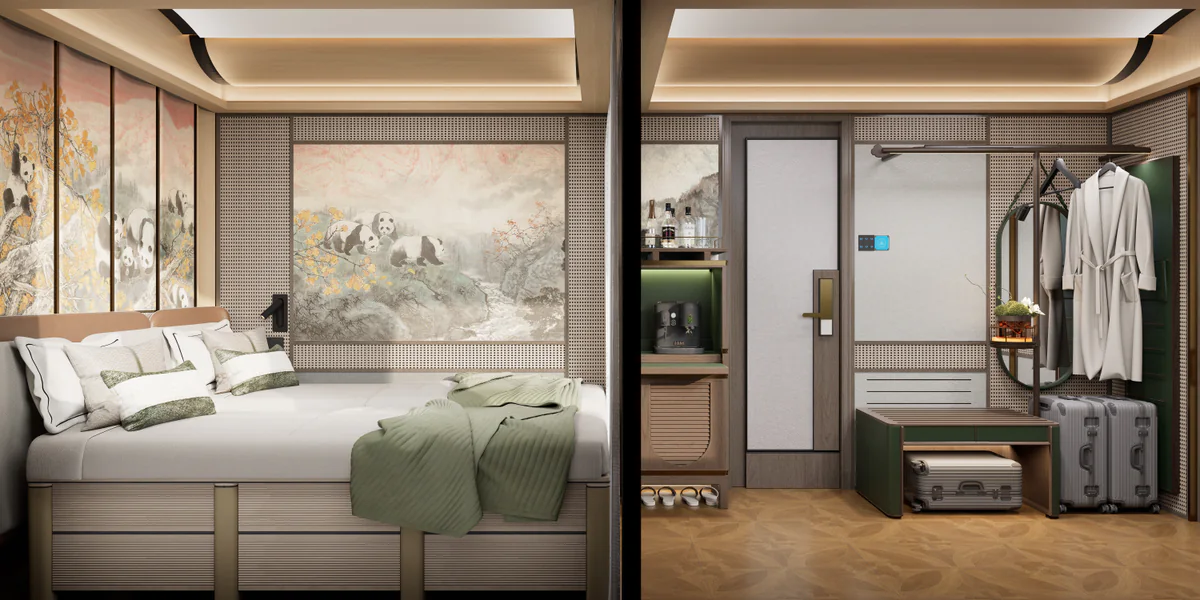
In the Huajian panda suite concept, that familiar shape becomes part of a baoxiang flower pattern. The stylised blossom, associated with Buddhist decorative art and traditional textiles, gives the panda a place within the older visual language of the train.
The effect comes down to small details. A panda-shaped bedside lamp casts light over gold-toned patterns. The room's name, Huajian, means "among flowers." The panda is part of that floral setting.
GOLDEN PANDA EXPRESS
A story in motion
From the Shaocheng welcome carriage to the dining rooms, Yunque lounge and Huajian suite, the design follows a sequence of stories from Sichuan. Ancient silk leads into Han brocade, a Tang poet's Chengdu and the panda imagery of today.
PANDA ROAM's October 2026 presentation describes PANDA TRAIN · GOLDEN PANDA EXPRESS as a planned 18-carriage train for 66 guests. Its associated Xingwei · Jiangyu journey is presented as a 16-day itinerary through northern and southern Xinjiang. Those are the source's product plans; the interiors shown here are design visualisations.
The article's idea is simple: walking through the train should feel like moving through chapters of the region's past. A woven pattern, a table setting or a bedside light gives each chapter something tangible.